Showing posts with label Valletta. Show all posts

Wednesday, July 20, 2016

Elvis Plays the Crystal Palace

Day 3 – Ancient Capitals, Rabar & Mdina, Malta

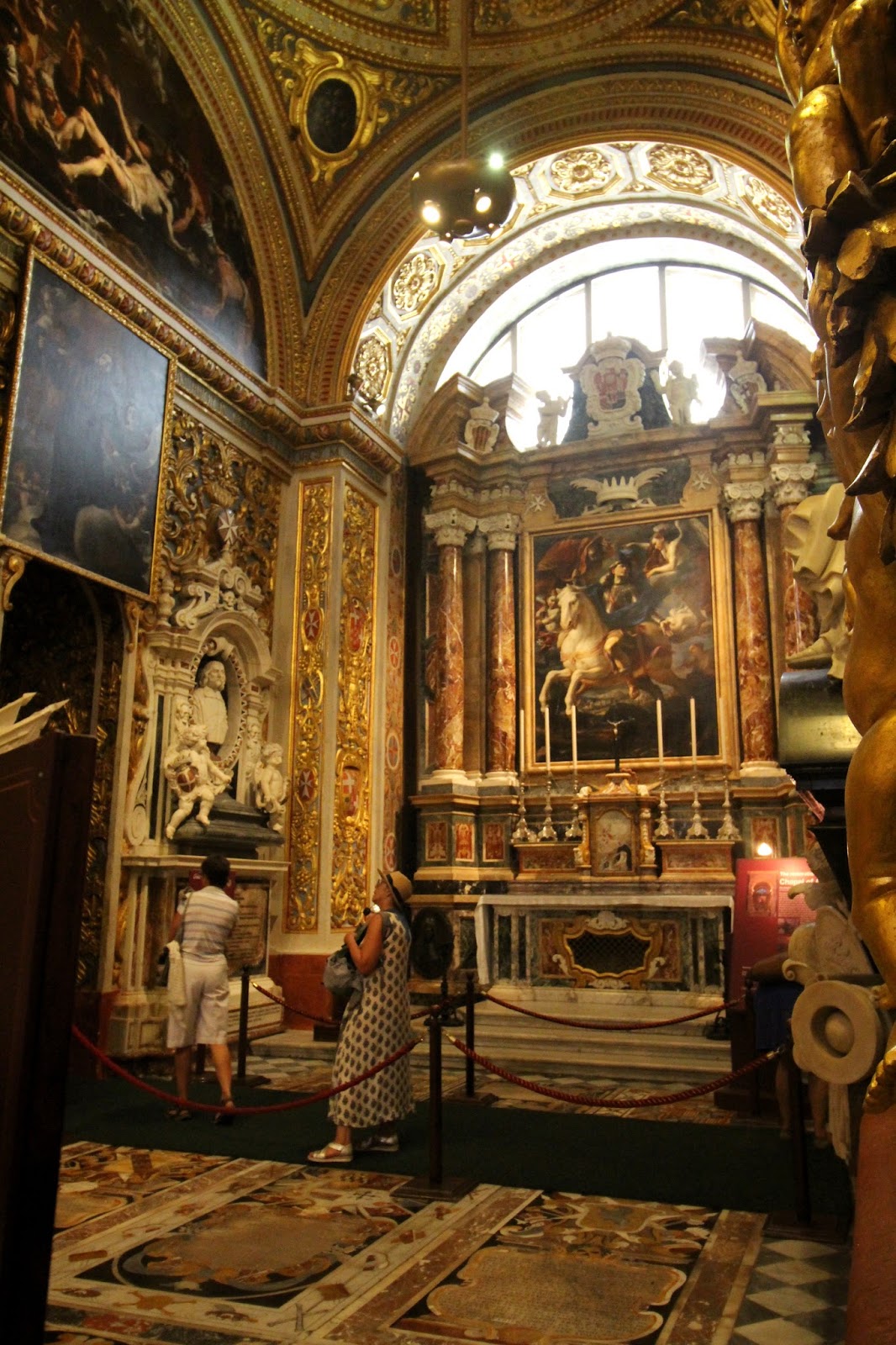
On Saturday morning in Valetta, we were finally able to squeeze into St John’s Cathedral, a froth of gold and silver, expressive marble statues and brilliant coloured art works. This could be described as nothing less than typical Baroque exuberance. 

The special, special treat however was seeing in the flesh, two of Caravaggio’s masterpieces – the lustrous and emotive “The Beheading of John the Baptist” (1608) and subdued “St Jerome”.  (No pictures were allowed.Although Caravaggio was initially granted a Knighthood, his many misdemeanours caught up with him, and despite his artistic talent, he was eventually expelled from the Order.  Saint John the Baptist is the patron saint of the Knights of Malta.


A Grand Master's Tomb
Floor Inlay
From Valletta, we bussed out to central Malta with intentions of visiting Rabat, Mdina and the Mosta Dome.  We eventually realised that visiting churches is off limits from Saturday afternoon until Monday mornings unless you are part of the congregation, so sadly missed seeing the famous Mosta Church Dome, a most unusually shaped church with its miraculous WWII experience.
   
In Rabat, we easily found the Domus Romana Museum and villa remains.  Located directly opposite the bus terminus in Rabat, this small but interesting museum was our chance to see something of Malta’s time under Roman rule.  The Domus Romana was once a luxurious villa and the fine collection unearthed from the site gives an understanding of the lavish lifestyle led by its occupants.


Rabat also has a strong connection with early Christianity. St Paul, following his shipwreck off the coast of Malta in 60 AD, is said to have lived in a nearby grotto.  We managed to find St Paul’s catacombs, an ancient complex of burial chambers hewn from soft rock.  The grounds were well signposted and supported with information on the central role these tombs played when Christians were persecuted by their Roman masters.

Is there a Saint David?
St Paul's Catacombs
Our tracks took us through the backstreets of small town Rabat.  A large but discreet crowd gathered at the town square to farewell an obviously respected community member.  Others lingered outside the Crystal Palace, just one of the many seedy village bars that seem to attracted older men for an afternoon chat and drink with friends.  Elvis tunes drifted over quiet evening streets.  Look!” whispered the Cap’n, “That bloke looks just like Elvis.  Had we indeed discovered the King’s secret hideaway?  Elvis was, quite naturally, camera shy...
 

With closing time of many sites & museums fast approaching we could only peer through the gates at the Mdina Citadel, Malta’s ancient capital, briefly. 

We had decided on skipping it, and the many and outlying temple sites (admission is included in the Heritage Pass but it is far easier to travel by car than bus), and instead make our last day an excursion to Gozo Island.  There in Victoria, we would find another, and suitably impressive, Gran Castello to explore. 

Simply put, you can't do it all!


Sunday, July 17, 2016

Cannon Fodder

Day 2 – Il Burgu, Malta
Collachio still has a few
bargain buy homes!
Burgu Piazza

The eastern shore of Grand Harbour is made up of three slim fingers, L-Isla, Il Burgu and Il Kalkara. These fort & defensive wall covered enclaves are known as the Three Cities.  Il Burgu held the most interest for us as it was here that the Knights first built their auberges (inns) when they arrived on Malta.  This district, Collachio, is now quiet and rather charming, with narrow cobbled streets and well cared for homes.  After prowling through the area for a bit, our next stop was the Inquisitors Palace.
Chapel, Inquisitors Palace

Fine marble staircase
Beautifully carved pulpit
Following the Great Siege, the Knights apparently “relaxed” a little - well, a bit too much for Rome anyway.  The Pope dispatched an Inquisitor to bring the Order back into line.  Needless to say, the Inquisitors Palace was rather luxurious for those who sat in judgement, but we all know the story of the hundreds of years of the Inquisition.  This delightful Palace with its pleasant courtyard garden also served as the court and jail for naughty Knights. 
The Naval Museum looks like fun....
St George also featured - quite often!
After the horrors of the Inquisitors, it was time to check out a British bakery.  In the 19th c, the British constructed a warehouse on Il Burgu’s waterfront to make and supply bread for its forces.  The Naval Museum is now proudly housed here.  Although GS was initially disconcerted by banks of engines and displays of tools, it turned out to be a very interesting record of Malta’s seafaring traditions. Bread and minestrone featured on the provisioning list, even for slaves. 
Knights of St John also had a serious fleet (Naval Museum)

Fort St Angelo to the left, Super Yachts to the right...
This view is taken from where Mega yachts languish in splendour 
Further along the seafront (beyond the chandlery we just had to visit and the expensive Camper & Nicholson Marina opened by HRH QE2 no less) lies the imposing Fort St Angelo.  Despite no indication to the contrary, it is NOT open to the public.  We were unceremoniously waved away. 

Fort St Angelo was home to the Grand Master until the island’s capital, Valletta, was constructed.  No checking for the "pit" deep underground where naughty Knights spent time in reflection then!

Many of the old mansions had expressive faces carved onto their soft stone walls.  This one (left) is hard to see as he was high up on a second storey but we're sure he's telling us to mind our manners or we'll be on a slippery slope to a fiery place. Just like naughty Knights....

Burgu Waterfront 
With time to spare, we headed back into Valletta to take in the Archaeology Museum and its astounding collection of artefacts from 5000 years ago.  The display was well set out, showing some amazing discoveries found across Malta. 

The famous Hal-Saflieni Hypogeum (4000 – 2500 BC & no, that’s not too many zeros!) allows only 80 visitors a day, so forget short notice visitors like us.  Also, during this peak tourist season it was closed (??) for ongoing restoration, so the Museum was our only hope of finding out more about this amazing Neolithic construction and civilization.

The Sleeping Lady - from Malta's ancient temples

The Archaeology Museum is housed in an impressive Palace!
We again in the evening, sat down by the dock watching locals busily setting up for a very important religious festival and listening to the nightly ritual (and early morning too) of cannon fire echoing around the harbour. 
Getting ready for an important festival


Saturday, July 16, 2016

Knights in Fine Armour

Day 1 - Valletta, Malta
Auberge de Castile - once a rather glamorous 'inn" for Knights
We had already been suitably “wowed” by the vast network of substantial defensive walls, built by the Knights, lying quite plainly before us as the ferry slid in to Grand Harbour.  It is an immediate confrontation; Malta’s brutal history and strategic position intentionally obvious. 

Our exploration started with Valletta and an obliging Tourist Information office to locate a Tallinja Card – unlimited bus travel for 7 days (21) and a Heritage Malta Multipass (Seniors at 38) for prepaid entry to 22 World Heritage sites across Malta (and the Aquarium), valid for 30 days.  In our 4 days, we easily used up the value & more of these cards.
La Sacra Infermeria - a hospital for Knights & others

After a brief stop to admire the stately Auberge de Castile (now the President’s Office), we decided it would be better to start with “The Malta Experience”( located at Valletta’s tip), an interesting 45 minute presentation that covered the amazing breadth of this Island’s history - an ongoing tussle beginning with Neolithic, Phoenician, Greek, Roman, Arab, and Norman settlement and conquests.  The Spanish, French (Napoleon) and British (Nelson) had an impact on the island as did its immersion in both World Wars.  A sobering introduction indeed but one that set us up for our sightseeing jaunt.  From here, we moved across to La Sacra Infermeria (1574), the large hospital constructed by the Knights in accord with their charitable practices and caring for the sick.  The Holy Infirmary was considered medically as the most advanced of its time and even then naturopathic practices were in evidence and held in high regard.  Women however, were not treated at the hospital.  Knights were to be kept free from impurity in every sense!
The restored Fort St Elmo & Barracks Parade Ground

View toward Manoel Island west from Fort St Elmo
From here, it was a mere hop to Fort St Elmo and the National War Museum, not on our Top Ten list, but as Fort St Elmo fell during initial attacks in the Great Siege, we thought it worth a look.  Impressive was the tiny and plain chapel, where Knights died defending the Christian faith against an imposing legion of Ottoman attackers.  Jean de la Vallette, at age 70, led his Knights to victory against his adversary, Dragut Rais.  The fort has since been modified and now serves in the role of providing an interesting historical account of its pivotal role in Malta’s history.
A section of the Great Siege Frieze 1575 in the Grand Master's Palace

Back past the Siege Bell Memorial and the Lower Barrack Gardens, we made for the Grand Master’s Palace, official residence (with lots of comforts & crammed full of goodies) from 1571.  Nowadays, it is the Office of the President and seat of Parliament and under extensive conservation/restoration.  We however had admission to the State Rooms (and the impressive Great Siege Frieze painted in 1575) and the well-stocked Armoury.   Leaving the Cap’n to imagine himself cloaked in a made-to-measure tin can (Oh, wait – he’s already done that but at least it had tracks!) in the Armoury, GS slipped off to the National Museum of Fine Arts to be impressed by its medieval collection and evidence perhaps, of Malta’s inclusion on the Grand Tour - a small Turner watercolour of Malta and a fine set of Mervyn Peake sketches. 
Calling it a day, we sat outside down by the water in a little restaurant close to Kalkara Marina watching:
  1. A really mean surge rock the fleet (a good decision to take the ferry – yes?), and
  2. France win the European Cup semi-final (& not popular with the locals it would seem) against Germany.
Steep streets in Valetta
Chapel defended to the death by Knights

More interesting body armour; bad dreams anyone?

Friday, July 15, 2016

Sue & Tony’s Malta

Valletta, Malta

An Overview

Evening down at Kalkara Marina
This itinerary for our Malta stopover had been developed under the watchful eye of Sue & Tony, Maltaphiles and knowledgeable sailing enthusiasts!  We are truly appreciative as it would be quite possible to spend weeks on Malta (without covering the same ground), so together with the DK Top Ten Guide, we were organised.
We had also decided to take the fast ferry to Malta rather than sail.  Time (Schengen time) was not on our side to spend the necessary weeks to undertake this venture by cruising.  Before leaving Syracuse, we also moved WJ3 into the Syracuse Marina for safety & securtiy's sake.  

Our initial visit plan for Malta over our 5 night stay was to spend a day each in:
  • Valletta
  • Birgu
  • Rabat & Msida
  • Ancient Sites - Temples & the Hypergium
Valletta Defensive Walls
We later modified this in the knowledge that our bus from Kalkara to the Valletta Bus Terminus took 30 minutes, and all buses beyond Valletta moved at a speed dictated by tourist season traffic and modest roads.  Schedules, even in Kalkara were hard to predict, so we learned to be patient, very patient.

We also found useful information on Cruisers Wiki, MySailing and Noonsite. (Ed Note 2024: The Wiki has not been updated for years. Noonsite has been sold (2008) and is now behind a membership wall.)  
View into Grand Harbour
Now then, time for some history; no groaning, please!  The Knights of St John were founded in the 11th c in Jerusalem as an Order of Chivalry.  They were organised by chapters according to country of origin, were of noble birth and presided over by a Grand Master.  By the 13th c, the Knights, after the fall of Jerusalem, moved to Rhodes establishing it as an island fortress.  After the Ottomans then ousted the Knights from Rhodes in 1522, Charles V, the Holy Roman Emperor, offered them a home on Malta (for an annual payment of a Maltese Falcon).  The Ottomans again attacked.  After successfully repelling them in the Great Siege of 1565, the Knights committed to some dramatic reconstruction of their fortified island home.  Malta finally fell to the French (under Napoleon who ransacked the place) in 1798 and to this day the Knights of St John remain stateless. Charitable and religious work is now the primary function of this Catholic Order.

Thursday, July 14, 2016

On the Road, Sicilian Style

Valletta, Malta

An Easy Excursion?


You would think, would you not, that getting a mere 120km to a sizeable (and international) ferry port would be easy?  Pozzallo is serviced by train, bus and a smart new main road (still under construction).  Well, this is Sicily and buses don’t run early and neither does the train, so the ferry provides a bus, leaving from the International Airport, a similar distance north of here.  We waited and waited at the appointed pick-up destination for the 6.15am bus.  By 7.30, we knew it wasn’t coming.  Finally we found someone who could speak English; the consensus (our new friend and a local bus driver, including all his passengers) was that we should catch the 8am local bus from the nearby Syracuse terminus, which of course, meant missing our ferry to Malta.  In desperation, we called the taxi that had picked us up from the marina and for a mere 80 and a drive “with a little bit fast”, we made our ferry – just in time to board.  Thank you Giancarlos, what a star!
Are we coming or going?
Needless to say, our collective moods were lethal.  Still, after the 90 minute superfast ferry ride (a Malta-run and on time concern) across to Valletta, there was more to come…. 

Breaking through a barrage of taxi drivers at the port who for 20 offered to take us to our hotel, we lucked upon a bus stop with a 2 fare to our destination.  Despite the confusion over Marina Street and marina (meaning beach in Italian), our bus driver let us off at desolate Fort Rinella.  His problem solved (i.e. he got us out of his bus), he pointed us down an even more desolate road, leaving us with a bit of a hike in the heat and lots of stops to ask directions to our hotel, Villa del Porto, on Marina Street. 
About time you made it, I've been waiting for ages!!
Despite the very early start, we had little of the day left, so after a brief respite in our air conditioned room and a refreshing cold shower (by choice!), walked to the local village shops for a pizza and a medicinal beer.  Finally, we could relax!  Orientating ourselves, we noted that Kalkara Marina is on Marina Street too and the beach near Fort Rinella, just over the ridge.  The bus stop we really needed was, naturally, almost in front of the hotel!
Kalkara Marina and Il Birgu in background