Showing posts with label Rabat. Show all posts

Wednesday, July 20, 2016

Elvis Plays the Crystal Palace

Day 3 – Ancient Capitals, Rabar & Mdina, Malta

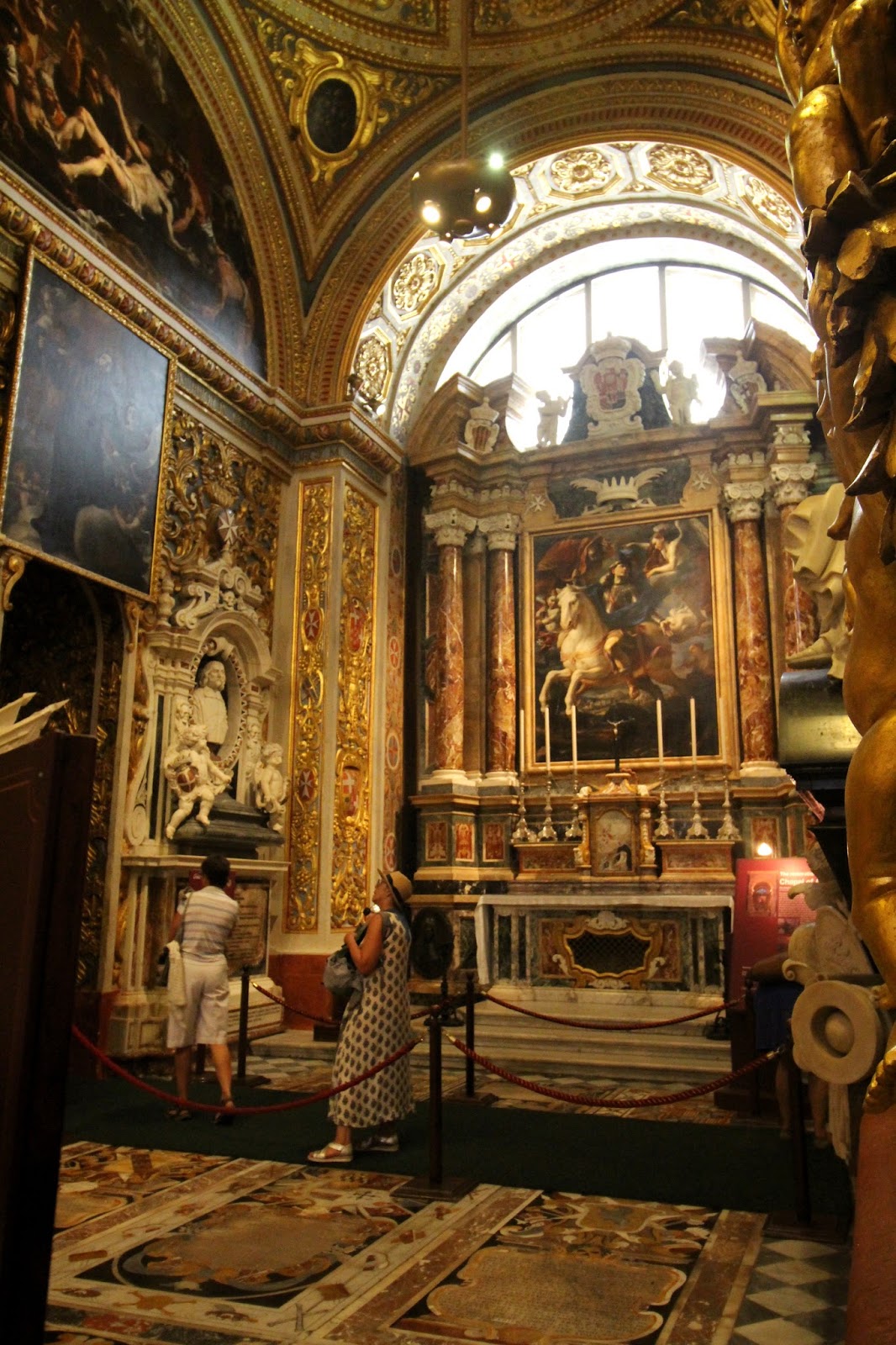
On Saturday morning in Valetta, we were finally able to squeeze into St John’s Cathedral, a froth of gold and silver, expressive marble statues and brilliant coloured art works. This could be described as nothing less than typical Baroque exuberance. 

The special, special treat however was seeing in the flesh, two of Caravaggio’s masterpieces – the lustrous and emotive “The Beheading of John the Baptist” (1608) and subdued “St Jerome”.  (No pictures were allowed.)  Although Caravaggio was initially granted a Knighthood, his many misdemeanours caught up with him, and despite his artistic talent, he was eventually expelled from the Order.  Saint John the Baptist is the patron saint of the Knights of Malta.


A Grand Master's Tomb
Floor Inlay
From Valletta, we bussed out to central Malta with intentions of visiting Rabat, Mdina and the Mosta Dome.  We eventually realised that visiting churches is off limits from Saturday afternoon until Monday mornings unless you are part of the congregation, so sadly missed seeing the famous Mosta Church Dome, a most unusually shaped church with its miraculous WWII experience.
   
In Rabat, we easily found the Domus Romana Museum and villa remains.  Located directly opposite the bus terminus in Rabat, this small but interesting museum was our chance to see something of Malta’s time under Roman rule.  The Domus Romana was once a luxurious villa and the fine collection unearthed from the site gives an understanding of the lavish lifestyle led by its occupants.


Rabat also has a strong connection with early Christianity. St Paul, following his shipwreck off the coast of Malta in 60 AD, is said to have lived in a nearby grotto.  We managed to find St Paul’s catacombs, an ancient complex of burial chambers hewn from soft rock.  The grounds were well signposted and supported with information on the central role these tombs played when Christians were persecuted by their Roman masters.

Is there a Saint David?
St Paul's Catacombs
Our tracks took us through the backstreets of small town Rabat.  A large but discreet crowd gathered at the town square to farewell an obviously respected community member.  Others lingered outside the Crystal Palace, just one of the many seedy village bars that seem to attracted older men for an afternoon chat and drink with friends.  Elvis tunes drifted over quiet evening streets.  “Look!” whispered the Cap’n, “That bloke looks just like Elvis.”  Had we indeed discovered the King’s secret hideaway?  Elvis was, quite naturally, camera shy...
 

With closing time of many sites & museums fast approaching we could only peer through the gates at the Mdina Citadel, Malta’s ancient capital, briefly. 

We had decided on skipping it, and the many and outlying temple sites (admission is included in the Heritage Pass but it is far easier to travel by car than bus), and instead make our last day an excursion to Gozo Island.  There in Victoria, we would find another, and suitably impressive, Gran Castello to explore. 

Simply put, you can't do it all!


Thursday, October 18, 2012

Morocco Top Ten: Finding Fossils

Meknes, Morocco

#7.  Visit Imperial Cities & Roman Ruins in a day


Entrance to old Medina, Rabat
Rabat is Morocco’s political and administrative centre.  It is largely deserted of tourists, so we were able to roam at will, avoiding a local demonstration (and riot police), into the depths of the quiet medina.  We emerged at the entrance to a whitewashed Kasbah balancing neatly on cliffs overlooking a somewhat subdued Atlantic Ocean.  Given a walking tour map, we explored narrow cobbled streets, escaped from the heat in peaceful Andalucian Gardens and took in our first museum, the Musee de Oudaias, housed in a former palace.  From here we caught the train, 2½ hrs (in second class so that locals could appreciate fully our appalling French or Arabic) to Meknes. 
Meknes City Gates
Meknes (named for the original Meknassis Berber tribe 10th c) is a modest town that we explored at leisure.  Youssef had set us another walking tour (having all returned after the last), and somehow our navigational skills held out yet again – although some were sorely tempted by market stalls of goodies along the way.  Sultan Moulay Ismail (1672-1727) made Meknes his capital and managed to control various warring factions and colonial powers to bring peace to a consolidated Morocco.  He was not only responsible for Morocco’s golden age but his family connections extend to the current monarchy.
Green, Pink or Black Olives, Madam or perhaps Preserved Lemons
On our way to Volubilis, we stopped briefly to see the pilgrim town of Moulay Idriss.  Each year thousands cram into this tiny town to celebrate the life of one of Morocco’s most venerated religious leaders.  From our vantage point, the town is said to look like a sleeping camel.  A fossil hawker literally appeared from nowhere, hopeful for a sale or two. We had been warned about the proliferation of fake goodies and therefore did not make his day!
Roman History in Volubilis
Volubilis was once a major Roman outpost (2-5th c) of the province of Mauretania; its wealth derived from trade in commodities such as oil, wheat and wild animals for Rome’s gladiatorial exhibitions.  We met local guide Abdelhay, who explained that less than half of the site had been excavated, and much had been destroyed in the 1755 earthquake that rocked Portugal.   We certainly walked the walk and talked the talk as he took us back in time, showing us exquisite mosaic floors, the grand Triumphal Arch (217), public baths and houses of ill repute. Here, the Cap’n paid homage to certain Roman gods – let’s hope these photos don’t make it on Facebook!
It was a fascinating visit to this UNESCO World Heritage site (1977) and an opportunity to get close to Roman ruins without the crowds. The area is gradually being developed with a museum in the pipeline and further digs to explore  areas not yet excavated.  Later, whilst sheltering from afternoon heat at a nearby cafe, we developed our growing taste for refreshing, sugary mint tea.
Intricate Mosaic Floors Volubilis