Friday, July 29, 2016

Riding the Rails


Noto, Sicily

Given recent and exhausting dealings with public transport in Sicily, we mooted sightseeing options.  Closest was Noto, a hilltop village noted for its flamboyant Baroque architecture.   Trains left Syracuse; we could only hope they returned.


After a brisk walk to the station in the early morning heat, it was a welcome relief to note that a. there actually was a train; b. it was air-conditioned, and c. it almost left on time.  Our stop at Noto was at the bottom of the hill, needing a not-so-energetic but 15 minute climb.  Buses do not meet trains and not many travellers use trains.  It’s complicated and very Sicilian, or so it would seem.
Minor Basilica of St. Nicholas of Myra, the Noto Cathedral
Noto is a UNESCO World Heritage site, famous for its Baroque constructions.  An earlier town was destroyed in an earthquake (1693).  Architects of the time were keen to leave their mark and, I presume, families had sufficient means to accommodate this rebuilding.  Consequently, within a small and easily walkable area, it is possible to see palaces, convents, churches and mansions alike, all covered in exuberant features that typify the Baroque style.


We arrived at the beautifully shaded Viale Marconi and in front of the Porta Ferdinandea, decided a coffee granita was the perfect way to start our tour.  From there, we followed our guide book’s walking tour, making our way through clearly planned streets, lots of stairs and ultimately into Palazzo Nicolaci Villadorata.  This was one of the few interiors open (other than churches), so we took a stroll through its lavish rooms, wondering if the chandeliers came from Venice….  

Back down to the very deserted train station, we sat on the rim of a crumbling fountain (no seating for passengers) in a garden full of weeds.  Once this would have been quite lovely – not anymore!  Despite our concerns, the train arrived on time.  We were still the only ones about, the Cap’n concerned we were going to be mugged.  No gunslingers from the OK Corral showed up; just a quick ride back to Syracuse, our travelling aspirations in Sicily more than fulfilled.

Friday, July 22, 2016

An Arrow's Flight

Day 4 – Going for Gozo, Malta
The Inland Sea, Gozo
We knew this was going to be a long, public transport day but we hoped to be able to cover a few of Gozo’s best sites.  Our journey at least had been eventful with the bus taking us up close again to Mosta Cathedral, a couple of very popular resort beaches, deserted craft villages and a picturesque crenelated Red Tower sitting high on Marfa Ridge.  The ferry took us past tiny Comino Island; it was easy to spot the Blue Lagoon’s brilliant turquoise waters on this sunny day. 
Perhaps just a little bigger than Dangar's ferry

Bustling Mgarr
We caught the bus at Gozo’s ferry port, Mgarr, and then changed at Victoria for Dwejra, famous for its panoramic, soaring cliffs and wave-like rock formation.  We walked out over fossil-strewn rocks to take photos of Fungus Rock and the Azure Window, then headed down a dusty track to the Inland Sea, an almost enclosed lagoon, with a cave like opening and room enough to squeeze a small armada of tourist boats out to sea for stunning views along the coast.  The Maltese love their holiday huts and manage to squeeze large families into spaces smaller than a garage for summer fun.  The Inland Sea was no exception and hut occupants happily shared their tiny plot with cafes, ice-cream trucks, boat tour operators, divers, swimmers and loads of visitors in this less than private setting.  All in the sweltering sun.
The Azure Window 2016.  I believe it has since, rather sadly, collapsed (2107).

Back in Victoria, we headed for the imposing and recently made-over Gran Castella.  Although smaller than Mdina’s commanding fortified city, its buildings, including the cathedral (1716) was no less impressive. 

We did though visit the Folklore Museum.  Set over 3 terraced noble’s homes, the museum contained items from everyday rural use and featured re-created rooms.  The houses themselves were fascinating labyrinths, no doubt designed to provide easy escape from enemies. 

Gozo was regularly and brutally attacked; once all of its people (6000) were taken into slavery.  Times were so tough that until 1673 laws enforced all citizens to stay at night within the Citadella’s walls.  Interestingly, we were also told that street lengths were only as long as an arrow’s flight.
A beautifully restored Gran Castella

Inner Courtyard, Noble's House
We made our way through the Norman ruins (12th c & yet to be restored), to find the Old Prison.  A friendly staffer told us what to look for around the rooms and gave us a potted history of its activities.  Even the most famous of the Grand Masters spent a little time here.  I wonder if he was one of the many occupants who left their mark engraved into the soft stone walls in these tiny, claustrophobic cells?  We would have been counting the days to freedom too!

It was bang on 3.30pm when we left Victoria, Gozo and I suspect we managed to find the all stops bus back to the ferry port.  Four slow Sunday hours later, we arrived at our hotel, with just time to catch our breath before dinner, yet again down at the Kalkara dock. Their food was so delicious! The European Cup Final was on and luckily, we had reserved a table.  Go, Portugal!!! 


The early, early start next morning for the first ferry back to Sicily was a rude shock but at least we found seats at the front for a last gaze over Valletta.  Needless to say, our feet touched the dock in Pozzallo at nine, just 5 minutes after the train had left for Syracuse.  The next direct bus wasn’t until 3pm & the train at 3.40 – all expertly coordinated no doubt, to leave before the arrival of the next ferry.  For sanity’s sake, we forked out yet another €80 of our rapidly diminishing travel funds for a taxi.  God is most certainly on the side of the Sicilians....  Either that, or they learned their expert bargaining skills from Egyptians traders many years ago.

Wednesday, July 20, 2016

Elvis Plays the Crystal Palace

Day 3 – Ancient Capitals, Rabar & Mdina, Malta

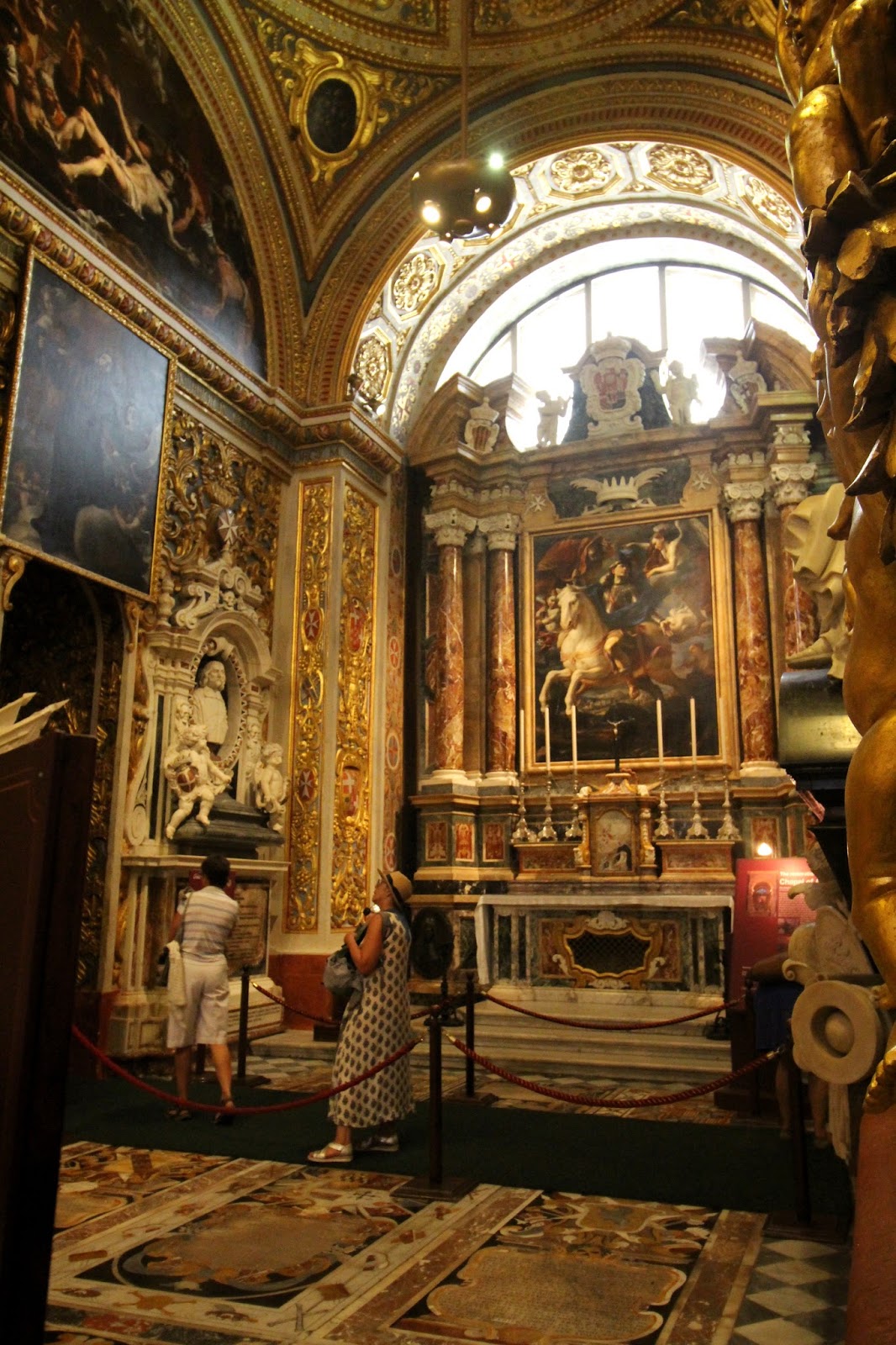
On Saturday morning in Valetta, we were finally able to squeeze into St John’s Cathedral, a froth of gold and silver, expressive marble statues and brilliant coloured art works. This could be described as nothing less than typical Baroque exuberance. 

The special, special treat however was seeing in the flesh, two of Caravaggio’s masterpieces – the lustrous and emotive “The Beheading of John the Baptist” (1608) and subdued “St Jerome”.  (No pictures were allowed.)  Although Caravaggio was initially granted a Knighthood, his many misdemeanours caught up with him, and despite his artistic talent, he was eventually expelled from the Order.  Saint John the Baptist is the patron saint of the Knights of Malta.


A Grand Master's Tomb
Floor Inlay
From Valletta, we bussed out to central Malta with intentions of visiting Rabat, Mdina and the Mosta Dome.  We eventually realised that visiting churches is off limits from Saturday afternoon until Monday mornings unless you are part of the congregation, so sadly missed seeing the famous Mosta Church Dome, a most unusually shaped church with its miraculous WWII experience.
   
In Rabat, we easily found the Domus Romana Museum and villa remains.  Located directly opposite the bus terminus in Rabat, this small but interesting museum was our chance to see something of Malta’s time under Roman rule.  The Domus Romana was once a luxurious villa and the fine collection unearthed from the site gives an understanding of the lavish lifestyle led by its occupants.


Rabat also has a strong connection with early Christianity. St Paul, following his shipwreck off the coast of Malta in 60 AD, is said to have lived in a nearby grotto.  We managed to find St Paul’s catacombs, an ancient complex of burial chambers hewn from soft rock.  The grounds were well signposted and supported with information on the central role these tombs played when Christians were persecuted by their Roman masters.

Is there a Saint David?
St Paul's Catacombs
Our tracks took us through the backstreets of small town Rabat.  A large but discreet crowd gathered at the town square to farewell an obviously respected community member.  Others lingered outside the Crystal Palace, just one of the many seedy village bars that seem to attracted older men for an afternoon chat and drink with friends.  Elvis tunes drifted over quiet evening streets.  “Look!” whispered the Cap’n, “That bloke looks just like Elvis.”  Had we indeed discovered the King’s secret hideaway?  Elvis was, quite naturally, camera shy...
 

With closing time of many sites & museums fast approaching we could only peer through the gates at the Mdina Citadel, Malta’s ancient capital, briefly. 

We had decided on skipping it, and the many and outlying temple sites (admission is included in the Heritage Pass but it is far easier to travel by car than bus), and instead make our last day an excursion to Gozo Island.  There in Victoria, we would find another, and suitably impressive, Gran Castello to explore. 

Simply put, you can't do it all!


Sunday, July 17, 2016

Cannon Fodder

Day 2 – Il Burgu, Malta
Collachio still has a few
bargain buy homes!
Burgu Piazza

The eastern shore of Grand Harbour is made up of three slim fingers, L-Isla, Il Burgu and Il Kalkara. These fort & defensive wall covered enclaves are known as the Three Cities.  Il Burgu held the most interest for us as it was here that the Knights first built their auberges (inns) when they arrived on Malta.  This district, Collachio, is now quiet and rather charming, with narrow cobbled streets and well cared for homes.  After prowling through the area for a bit, our next stop was the Inquisitors Palace.
Chapel, Inquisitors Palace

Fine marble staircase
Beautifully carved pulpit
Following the Great Siege, the Knights apparently “relaxed” a little - well, a bit too much for Rome anyway.  The Pope dispatched an Inquisitor to bring the Order back into line.  Needless to say, the Inquisitors Palace was rather luxurious for those who sat in judgement, but we all know the story of the hundreds of years of the Inquisition.  This delightful Palace with its pleasant courtyard garden also served as the court and jail for naughty Knights. 
The Naval Museum looks like fun....
St George also featured - quite often!
After the horrors of the Inquisitors, it was time to check out a British bakery.  In the 19th c, the British constructed a warehouse on Il Burgu’s waterfront to make and supply bread for its forces.  The Naval Museum is now proudly housed here.  Although GS was initially disconcerted by banks of engines and displays of tools, it turned out to be a very interesting record of Malta’s seafaring traditions. Bread and minestrone featured on the provisioning list, even for slaves. 
Knights of St John also had a serious fleet (Naval Museum)

Fort St Angelo to the left, Super Yachts to the right...
This view is taken from where Mega yachts languish in splendour 
Further along the seafront (beyond the chandlery we just had to visit and the expensive Camper & Nicholson Marina opened by HRH QE2 no less) lies the imposing Fort St Angelo.  Despite no indication to the contrary, it is NOT open to the public.  We were unceremoniously waved away. 

Fort St Angelo was home to the Grand Master until the island’s capital, Valletta, was constructed.  No checking for the "pit" deep underground where naughty Knights spent time in reflection then!

Many of the old mansions had expressive faces carved onto their soft stone walls.  This one (left) is hard to see as he was high up on a second storey but we're sure he's telling us to mind our manners or we'll be on a slippery slope to a fiery place. Just like naughty Knights....

Burgu Waterfront 
With time to spare, we headed back into Valletta to take in the Archaeology Museum and its astounding collection of artefacts from 5000 years ago.  The display was well set out, showing some amazing discoveries found across Malta. 

The famous Hal-Saflieni Hypogeum (4000 – 2500 BC & no, that’s not too many zeros!) allows only 80 visitors a day, so forget short notice visitors like us.  Also, during this peak tourist season it was closed (??) for ongoing restoration, so the Museum was our only hope of finding out more about this amazing Neolithic construction and civilization.

The Sleeping Lady - from Malta's ancient temples

The Archaeology Museum is housed in an impressive Palace!
We again in the evening, sat down by the dock watching locals busily setting up for a very important religious festival and listening to the nightly ritual (and early morning too) of cannon fire echoing around the harbour. 
Getting ready for an important festival


Saturday, July 16, 2016

Knights in Fine Armour

Day 1 - Valletta, Malta
Auberge de Castile - once a rather glamorous 'inn" for Knights
We had already been suitably “wowed” by the vast network of substantial defensive walls, built by the Knights, lying quite plainly before us as the ferry slid in to Grand Harbour.  It is an immediate confrontation; Malta’s brutal history and strategic position intentionally obvious. 

Our exploration started with Valletta and an obliging Tourist Information office to locate a Tallinja Card – unlimited bus travel for 7 days (€21) and a Heritage Malta Multipass (Seniors at €38) for prepaid entry to 22 World Heritage sites across Malta (and the Aquarium), valid for 30 days.  In our 4 days, we easily used up the value & more of these cards.
La Sacra Infermeria - a hospital for Knights & others

After a brief stop to admire the stately Auberge de Castile (now the President’s Office), we decided it would be better to start with “The Malta Experience”( located at Valletta’s tip), an interesting 45 minute presentation that covered the amazing breadth of this Island’s history - an ongoing tussle beginning with Neolithic, Phoenician, Greek, Roman, Arab, and Norman settlement and conquests.  The Spanish, French (Napoleon) and British (Nelson) had an impact on the island as did its immersion in both World Wars.  A sobering introduction indeed but one that set us up for our sightseeing jaunt.  From here, we moved across to La Sacra Infermeria (1574), the large hospital constructed by the Knights in accord with their charitable practices and caring for the sick.  The Holy Infirmary was considered medically as the most advanced of its time and even then naturopathic practices were in evidence and held in high regard.  Women however, were not treated at the hospital.  Knights were to be kept free from impurity in every sense!
The restored Fort St Elmo & Barracks Parade Ground

View toward Manoel Island west from Fort St Elmo
From here, it was a mere hop to Fort St Elmo and the National War Museum, not on our Top Ten list, but as Fort St Elmo fell during initial attacks in the Great Siege, we thought it worth a look.  Impressive was the tiny and plain chapel, where Knights died defending the Christian faith against an imposing legion of Ottoman attackers.  Jean de la Vallette, at age 70, led his Knights to victory against his adversary, Dragut Rais.  The fort has since been modified and now serves in the role of providing an interesting historical account of its pivotal role in Malta’s history.
A section of the Great Siege Frieze 1575 in the Grand Master's Palace

Back past the Siege Bell Memorial and the Lower Barrack Gardens, we made for the Grand Master’s Palace, official residence (with lots of comforts & crammed full of goodies) from 1571.  Nowadays, it is the Office of the President and seat of Parliament and under extensive conservation/restoration.  We however had admission to the State Rooms (and the impressive Great Siege Frieze painted in 1575) and the well-stocked Armoury.   Leaving the Cap’n to imagine himself cloaked in a made-to-measure tin can (Oh, wait – he’s already done that but at least it had tracks!) in the Armoury, GS slipped off to the National Museum of Fine Arts to be impressed by its medieval collection and evidence perhaps, of Malta’s inclusion on the Grand Tour - a small Turner watercolour of Malta and a fine set of Mervyn Peake sketches. 
Calling it a day, we sat outside down by the water in a little restaurant close to Kalkara Marina watching:
  1. A really mean surge rock the fleet (a good decision to take the ferry – yes?), and
  2. France win the European Cup semi-final (& not popular with the locals it would seem) against Germany.
Steep streets in Valetta
Chapel defended to the death by Knights

More interesting body armour; bad dreams anyone?